FUE vs DHI cost: what you really pay for
When comparing FUE vs DHI cost, expect to pay a premium of 20% to 50% for DHI over standard FUE, because DHI requires specialized implanter pens and more intensive clinic labour. However, the surgeon's skill dictates your final result far more than the specific technique you choose.
Understanding the hair transplant market
Choosing to restore your hair is a major financial and personal decision. Once you decide to move forward with surgery, clinics will present you with a menu of medical acronyms. The two most common options you will encounter in today's market are FUE and DHI. FUE (Follicular Unit Excision) is the modern surgical standard, where hair groupings, known as grafts, are removed individually from the back of your head. DHI (Direct Hair Implantation) is a specialized variation of this process that changes exactly how those harvested hairs are placed into the thinning areas of your scalp.
Understanding the cost of different techniques is essential for protecting your budget and ensuring you do not overpay for marketing hype. Clinics frequently market DHI as a premium, top-tier service. They promise denser results, faster healing times, or a more comfortable patient experience. As an independent consumer advocate, GraftCost looks past the glossy brochures and sales pitches. We want you to understand the exact math behind these clinic quotes so you know precisely what you are funding when you sit in the surgical chair.
FUE vs DHI cost: establishing the baseline
To evaluate any premium pricing, you first need to understand the baseline price of the procedure. In the global hair restoration market, standard manual FUE sets the reference price. Every other surgical technique is priced relative to this foundation.
To give you a clear picture of the current market, standard FUE typically costs between $0.80 and $2.50 per graft in popular medical tourism destinations like Turkey. If you choose to stay in the US for your procedure, clinics generally charge between $5 and $10 per graft. These figures are market estimates, not quotes, but they provide a highly reliable starting point for your personal budget calculations.
DHI typically costs 20% to 50% more than standard FUE. Let us look at how this markup impacts a standard procedure. If you need a 2,500-graft case, a clinic in the US charging $6 per graft for standard FUE would quote you an estimated $15,000. If that same clinic applies a 30% premium for their DHI service, the price jumps to $7.80 per graft, bringing your total estimated bill to $19,500. That is a real sum of money. As a patient, you must decide if the mechanical differences of the DHI process justify a $4,500 price increase.
What exactly changes during DHI?
The extraction phase of a DHI procedure is completely identical to an FUE procedure. The surgeon still uses a micro-punch tool to remove individual follicles from your donor area one by one. The difference between the two methods lies entirely in the implantation phase.
In standard FUE, the surgeon first creates tiny incisions, known as recipient channels, in your scalp using a fine microblade. Afterward, technicians or the surgeon use fine forceps to manually place each individual graft into those pre-made channels. It is a distinct, two-step implantation process.
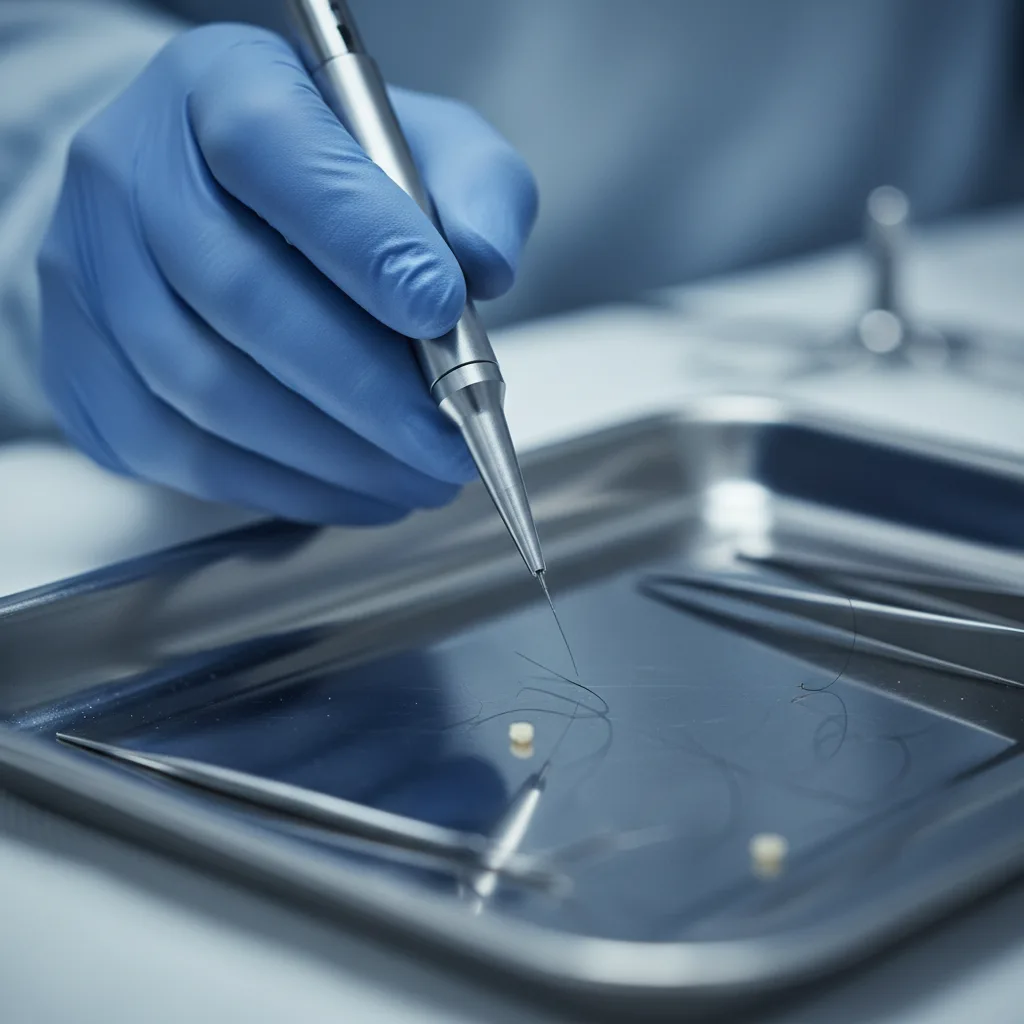
DHI uses a specialized surgical tool called a Choi implanter pen. During the surgery, a technician loads a single hair graft into the hollow needle of this pen. The surgeon then presses the pen directly into the scalp, which creates the incision and implants the graft simultaneously. This merges the channel creation and the graft placement into a single, fluid motion.
Comparing the market: a cost breakdown
When you review your clinic quotes, you will likely see other methods listed alongside FUE and DHI. Here is how the broader market prices these variations against the standard FUE baseline.
| Technique | Price vs FUE |
|---|---|
| Standard FUE | Baseline |
| Sapphire FUE | +10% to +20% |
| DHI (Direct Hair Implantation) | +20% to +50% |
| Robotic (ARTAS) | +20% to +40% |
| FUT (Strip Method) | −20% to −50% |
Verified ranges, not quotes. They vary by clinic and case.
Evaluating other popular methods
While DHI is the most common upgrade offered to patients, clinics may also present Sapphire FUE or Robotic extraction options during your consultation.
Sapphire FUE costs about 10% to 20% more than standard FUE. This method replaces the standard steel surgical blades with blades crafted from synthetic sapphire. Clinics note that sapphire blades retain their sharpness longer and allow for slightly cleaner incisions during the channel creation phase. You can expect a modest premium for these specialized blades, but it is important to remember that a sharper blade does not automatically guarantee a better aesthetic design.
Robotic FUE, frequently marketed under the brand name ARTAS, runs about 20% to 40% more than manual FUE. The robotic system uses advanced cameras and algorithms to map the donor area and automate the physical extraction of the grafts. The premium here covers the clinic's massive capital expenditure to purchase and maintain the robotic machine, rather than necessarily providing a superior aesthetic outcome.
At the other end of the pricing spectrum is FUT (Follicular Unit Transplantation). Also known as the strip method, FUT involves surgically removing a horizontal strip of skin from the back of the scalp. The surgical team then dissects this strip under microscopes to harvest the individual grafts. Because the extraction phase is much faster for the surgeon, FUT is the cheapest option available. It runs about 20% to 50% less per graft than FUE. The significant trade-off is that FUT leaves a permanent linear scar across the back of the head, which dictates how short you can cut your hair in the future.
Is the DHI premium justified?
Deciding if DHI is worth an extra 20% to 50% requires looking closely at your specific hair loss pattern and your personal budget. DHI offers a few distinct mechanical advantages that genuinely benefit certain types of patients.
First, the implanter pen provides excellent control over the angle, depth, and direction of the implanted hair. This makes DHI particularly useful for complex, detailed work like rebuilding a natural-looking hairline or filling in a thinning crown where matching the natural hair whorl is critical.
Second, DHI is often the preferred method for "no-shave" transplants. Because the fine needle of the Choi pen can navigate between existing hairs without damaging the nearby healthy follicles, surgeons can often perform DHI without requiring you to shave the recipient area. If you have a public-facing career and want a discreet recovery process, paying the premium to keep your existing hair length might be a highly worthwhile investment.
The surgeon always beats the tool
The most crucial lesson in hair restoration pricing is that the surgical tool is only as good as the hands holding it. According to leading institutions like the UK's Wimpole Clinic and various industry cost guides, the surgical technique matters far less to the final result than the surgeon's skill and experience.
An exceptionally skilled medical team performing standard FUE will consistently deliver better, more natural-looking results than an average or inexperienced team performing DHI. A Choi implanter pen cannot give a novice surgeon an artistic eye for facial framing, nor can it teach them how to distribute a limited supply of donor hair efficiently across a large bald area.
Furthermore, the total volume of hair moved dictates your final bill far more than the specific tool used in the operating room. A clinic's honesty regarding your required graft count is paramount to keeping your costs under control. You can learn more about how total volume impacts your budget in our detailed guide on how many grafts you need.
Making a confident financial decision
When you request quotes from different providers, always ask clinics to break down their pricing clearly. If they charge a premium for DHI, ask them to explain exactly why they recommend it for your specific anatomical case. Do not accept vague promises of better results. Demand clear, mechanical reasons based on your scalp's condition.
To truly understand what a hair transplant really costs, you must view the procedure as a comprehensive medical service. You are paying for the surgeon's time, the facility's safety standards, the medical team's experience, and the post-operative care program. The extraction and implantation tools are just one single line item on that much larger bill.
Please remember that a hair transplant is a serious surgical procedure, not merely a cosmetic retail purchase. The information provided in this article is general market information and pricing transparency, not medical advice. All decisions regarding your health, including which surgical extraction and implantation technique is safest and most appropriate for your specific type of hair loss, belong entirely with a qualified physician.
If you are ready to explore your options and want to see how these different methods impact a real-world budget, use our cost estimator to see how technique changes your all-in price based on your unique needs.
Sources: Wimpole Clinic, industry cost guides. See our sources and method.
Frequently asked questions
What is the cost difference between FUE and DHI?
Is DHI worth the extra money?
Is sapphire FUE worth it?
Does a more expensive technique give better results?
All cost figures are market estimates, not quotes, and pricing varies by clinic and individual case. GraftCost is independent and not affiliated with any clinic. This is general information, not medical advice; consult a qualified hair-restoration physician before making decisions.