Hair transplant cost by technique
Technique changes the price, but less than people assume, and less than graft count or country. Here is how FUE, DHI, Sapphire FUE, FUT and robotic methods compare, and where paying more actually buys something.
The techniques, side by side
Every modern method is a variation on two questions: how grafts are harvested, and how they are placed. The premiums below are relative to standard FUE, the baseline, and are verified across multiple sources.
The table shows what the price difference actually buys: not just a method, but a different scar and, for FUT, a different recovery. Premiums are relative to standard FUE, the baseline, and are verified across multiple sources.
| Technique | How it differs | Donor scar | Surface healing | Price vs FUE |
|---|---|---|---|---|
| FUE | Follicles extracted individually; the standard. | Tiny dots | ~10–14 days | baseline |
| Sapphire FUE | FUE with sapphire blades for the incisions. | Tiny dots | ~10–14 days | +8–15% |
| DHI | Grafts placed directly with an implanter pen; more control, more time. | Tiny dots | ~10–14 days | +25–50% |
| Unshaven / U-FUE | No-shave, discreet; more labour-intensive. | Tiny dots | ~10–14 days | +15–30% |
| Robotic (ARTAS) | Robot-assisted extraction; consistency, higher equipment cost. | Tiny dots | ~10–14 days | +40–60% |
| Body / beard (BHT) | Beard/body donor when scalp donor is limited. | Depends on donor | ~10–14 days | ~+20% |
| FUT / strip | A strip of scalp harvested at once; cheapest per graft. | Linear scar | Sutures ~10–14 days + permanent line | −20–40% |
Verified ranges, not quotes. Premiums vary by clinic and country. Surface healing is broadly similar across methods; the real trade-off is the FUT linear scar versus FUE dot scars. high confidence
FUE: the baseline
Follicular Unit Extraction harvests grafts one at a time and leaves no linear scar, which is why it dominates the market and sets the reference price. When a clinic quotes "per graft," it almost always means FUE.
DHI: the premium placement method
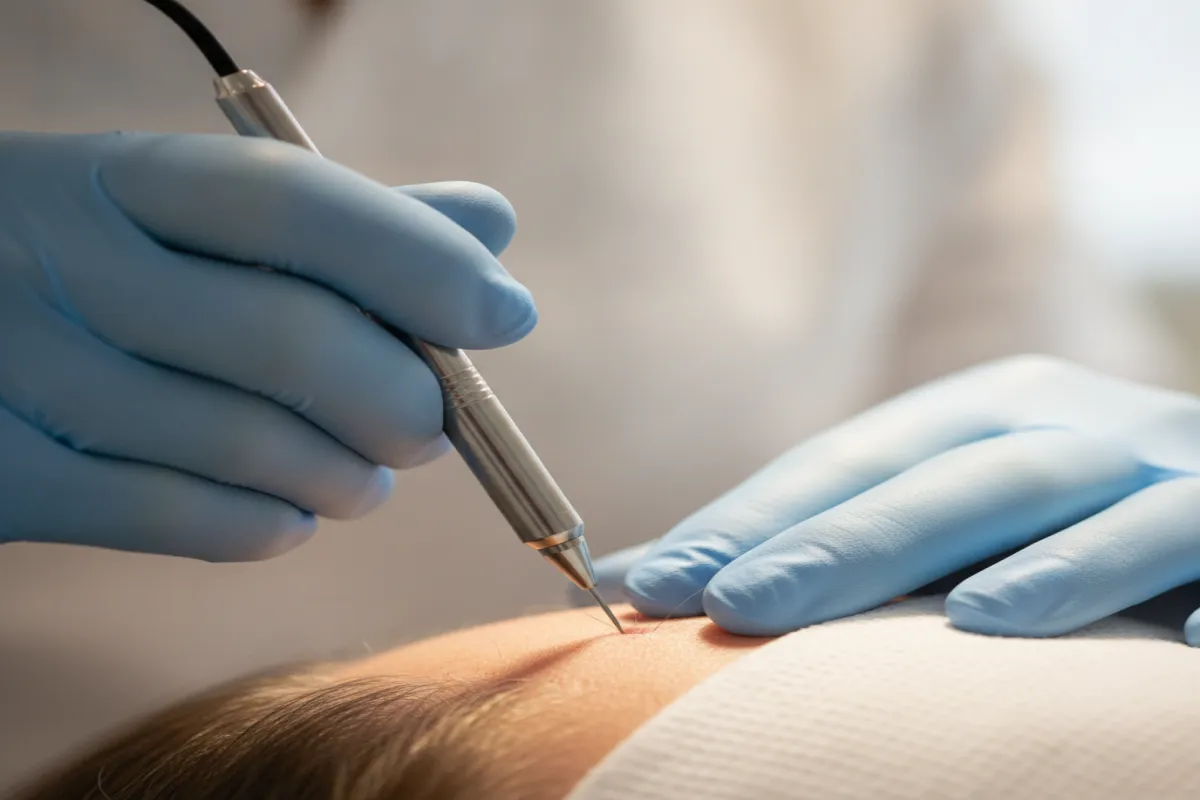
Direct Hair Implantation uses a pen-like implanter to place each graft without first creating separate channels. Surgeons who favor it argue it allows denser packing and finer control over angle and direction. It is more labor-intensive, so it sits at the top of the price range. The result depends on the operator's skill far more than on the tool.
Sapphire FUE: a modest upgrade
Sapphire FUE is standard FUE with sapphire rather than steel blades for the recipient incisions. The claimed benefit is smoother, denser channels and faster healing. The premium is usually small, and it is a reasonable add-on, but it is not transformative on its own.
FUT: cheapest per graft, with a trade-off
Follicular Unit Transplantation removes a strip of scalp from the donor area and dissects grafts from it. It is the most efficient way to obtain a very large number of grafts in one session, and the cheapest per graft, but it leaves a linear scar that limits very short haircuts. For some high-graft cases it remains the rational choice.
Does paying more change the result?
Up to a point. The biggest determinant of a good outcome is the surgeon's judgement and the team's execution, not the technique label. A skilled team doing standard FUE will beat an average team doing premium DHI. Choose the surgeon first, then the technique. Once you know your method, our estimator shows how it changes your all-in total.
Technique premiums are sourced across multiple references (2024–2026). See sources and method.
Frequently asked questions
Is DHI more expensive than FUE?
How much does FUE cost per graft?
Is sapphire FUE worth the extra cost?
Is FUT cheaper than FUE?
All cost figures are market estimates, not quotes, and pricing varies by clinic and individual case. GraftCost is independent and not affiliated with any clinic. This is general information, not medical advice; consult a qualified hair-restoration physician before making decisions.